
Transcript
Announcer:
Welcome to CE on ReachMD. This activity is provided by Prova Education. This episode is part of our MinuteCE curriculum.
Prior to beginning the activity, please be sure to review the faculty and commercial support disclosure statements as well as the learning objectives.
Dr. Richter:
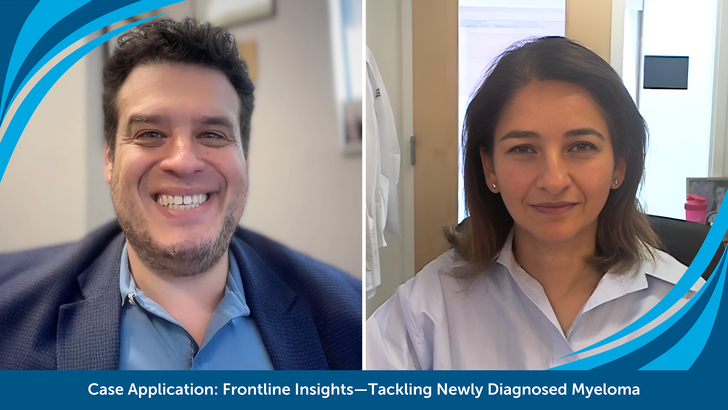
This is CME on ReachMD, and I'm Dr. Joshua Richter. Here with me today is the amazing Dr. Noopur Raje. We're discussing the potential role for CELMoD therapy in newly diagnosed multiple myeloma, and we'll start off with a case.
This is a case of a 70-year-old African American gentleman who is evaluated in the setting of newly diagnosed multiple myeloma and actually deemed transplant eligible. He goes on to receive a quadruplet therapy based on the PERSEUS trial with daratumumab, bortezomib, lenalidomide and dexamethasone. And although he achieves a VGPR with his induction therapy, he had several toxicities associated with lenalidomide, requiring a variety of dose reductions due to GI and hematologic toxicity. Originally starting off at 25 mg days 1 through 21 of the 28-day cycle, then lowering down to 15, and ultimately down to 10 mg by the time he finished induction therapy.
He went on to collect peripheral blood stem cells and receive high-dose melphalan with autologous stem cell rescue. He is now presenting to your office to discuss options in the maintenance setting.
Noopur, what are your thoughts on this case?
Dr. Raje:
So, Josh, this is an interesting case, and I think you and I see this in clinics so often and we do not talk about it often enough. We like putting people on lenalidomide maintenance, and this is the time that I would be thinking about maintenance treatment in somebody like himself.
What you have highlighted so nicely, though, is the fact that this patient had significant toxicities to lenalidomide. He had the GI toxicity, diarrhea, and those of us who've seen our patients, we know that it can really compromise day-to-day living for a patient, especially if somebody is a working person. It really interferes with their quality of life. The fact that the dosing had to be reduced and continued to be reduced, I can only imagine he's going to have a really hard time taking even the 10 mg, which we recommend, because he’s now posttransplant.
So this is one place where I would think about alternative approaches. We do have the novel new CELMoDs now. These, as I like to refer to them, are souped-up immunomodulatory drugs. They act on a protein called cereblon, which is an E3 ligase complex protein, and it is actually a drug like iberdomide, which is one of them. We have 2 CELMoDs. You have iberdomide and mezigdomide, and iberdomide is a drug which has been studied, and we are doing those trials as we speak in the maintenance setting. It is way more potent than lenalidomide. The dosing of iberdomide is a lot lower than what you would imagine of 25 mg of len and even 10 mg of len. And it is extremely well tolerated. It does not have the same necessary toxicity of GI related issues. It could have some hematologic toxicity, but in general, very well tolerated, and we're looking forward to the results of the maintenance with iberdomide.
So drugs which are easy, convenient, are drugs that we think about in the maintenance setting, so oral drugs would be something I would be considering, and I’m looking forward to seeing iberdomide approved in this setting, in this space.
Dr. Richter:
Absolutely. As am I. I think we always think oral drugs and lenalidomide as being fairly ubiquitous in myeloma, but not always the easiest to tolerate. And I think what we're definitely finding out in the clinic, especially with some of our patients who have the Duffy-null phenotype, that they may have prolonged periods of neutropenia. And I think one of the things that we've seen with iberdomide, is a lower degree of hematologic toxicity, which in many ways makes it a very optimal drug to give in the posttransplant setting as a maintenance, where the marrow may be even more sensitive than prior to some of these hematologic toxicities.
This has been really a great bite-sized discussion, but our time is up. Thank you so much for listening.
Announcer:
You have been listening to CE on ReachMD. This activity is provided by Prova Education and is part of our MinuteCE curriculum.
To receive your free CE credit, or to download this activity, go to ReachMD.com/Prova. Thank you for listening.

